PandaRC VT5804 AIR
Of the 81 other 5.8 GHz analog video transmitters in our database, 16 have a lower maximum power than the VT5804 AIR (400 mW, 26 dBm), 5 the same and 60 a higher one; the class median is 800 mW.
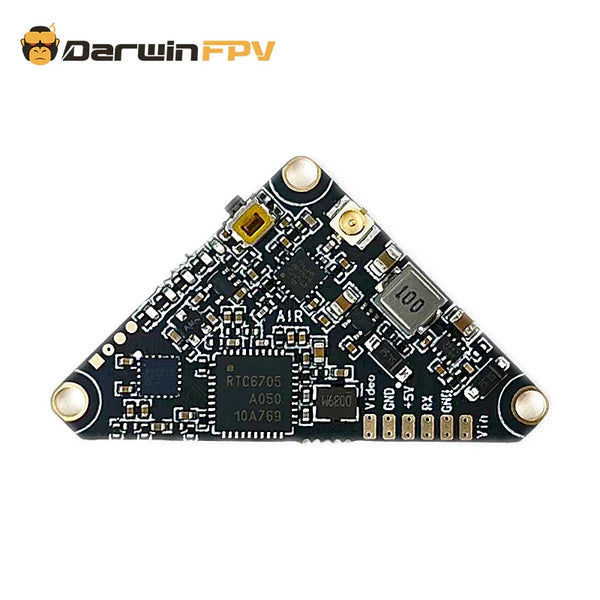
| System | analog |
|---|---|
| Max power | 400 mW |
| Power levels | 0 (pit) / 25 / 50 / 100 / 200 / 400 mW |
| Frequency range | 5.8 GHz |
| Input voltage | 6-26V |
| Power draw | 240 mA at 12 V (400 mW output) |
| Mounting | 25.5x25.5mm |
| Channels | 40 |
| Antenna connector | U.FL |
| Price (approx.) | 50.99 USD |
Choosing between systems? See analog vs DJI vs Walksnail vs HDZero.
Where this data comes from
Read 2026-09-24 off DarwinFPV's shop, which sells this board as the 'DarwinFPV VT5804 5.8G 25/50/100/200/400mW VTX' - but the board is not DarwinFPV's. Its back is silkscreened with PandaRC's logo and 'VT5804_AIR V1.0' (image 4 of 4, read at full resolution), so the brand column holds the maker and the note holds the seller: the fourteenth burst's lesson, that a vendor field is a distribution fact rather than a spec, arriving here from a manufacturer's own store rather than from a retailer. power_levels_mw is the listing's whole sentence, 'it support 6 gears of power: 0-25-50-100-200-400mW', and max_power_mw is its top step. input_voltage and antenna_connector are off the annotated wiring diagram the listing publishes as its fourth image: 'DC-IN(6-26V)' against the Vin pad, 'IPXE1 ANT' (the brand's spelling of IPEX1) against the u.FL, and a pad rail of Video / GND / +5V / RX / GND / Vin wired out as VTX, GND, 5V-OUT, SA, GND, DC-IN. The chip is an RTC6705 and the board is a triangle that fits a whoop or toothpick frame's rear corner. weight_g is empty: the listing states 'It's <=3g', which is a bound and not a measurement, and no scale photograph accompanies this part as it does the rest of this shop's transmitters. mount_mm is unstated. This entry's page is not a second citation for anything: this catalogue carried no PandaRC part before it. The wiring diagram labels the jack 'IPEX1 (U.FL)'; IPEX-1 is Hirose's name for the U.FL connector, so the column holds U.FL and this note holds the maker's own spelling. Extended 2026-10-07 against PandaRC's own product page for this board (www.pandarc.com/vt5804air, the maker site the seller never names; its body is served as a script, and the specification block reads 'Frequency Band: 5.8GHz. Channel: 40CH. Power: 0/25/50/100/200/400mW Switchable. Input Voltage: 6-26V, +12V/240mA @400mW. Video Format: NTSC/PAL. Dimension: 28.5x28.5x3mm. Mounting Holes: 25.5X25.5mm. Weight: <=3g (Without antenna)'). channels is that line's 40CH, which the page's feature list spells out as '40CH, including A, b, E, F, r' and its own frequency-table image prints as five rows of eight; mount_mm is the 'Mounting Holes' figure, which no source stated before - the 28.5x28.5x3mm beside it is the board, not the pattern. The maker's ladder confirms the power figures this entry took from the seller, 0/25/50/100/200/400mW, twice: in that line and in the LED diagram above the grid (one to five blinks for 25/50/100/200/400mW, plus a Fault light). The page contradicts itself once, in prose - control method 4 says 'change the power 25mW/100mW/200mW/400mW/600mW' - and that sentence is the only place a 600 mW step or a missing 50 mW step appears; the spec block and the LED diagram agree with each other and with the seller, so the stored ladder does not move. weight_g stays empty: '<=3g' is still a bound. No VTX table is stored although the page prints the full 5x8 grid - PandaRC states its power only in milliwatts and names its control protocol two ways on the one page (control method 1 'Smart Audio configuration' against an OSD walkthrough that selects Betaflight's VTX TR), and a vtxtable power value is mW for Tramp but dBm for SmartAudio 2.1, so the figures cannot be written down as values. The grid as read is kept in scratchpad/vtxtab/pandarc/ for the day PandaRC publishes a manual. power_draw is the maker's own supply figure, the tail of the 'Input Voltage: 6-26V,+12V/240mA @400mW' line in the specification block of PandaRC's product page (www.pandarc.com/vt5804air, body served as a script), re-read 2026-10-20. It is the VTX's input draw at its 400 mW top step, not its RF output.