T-Motor Pacer V3.2 2207
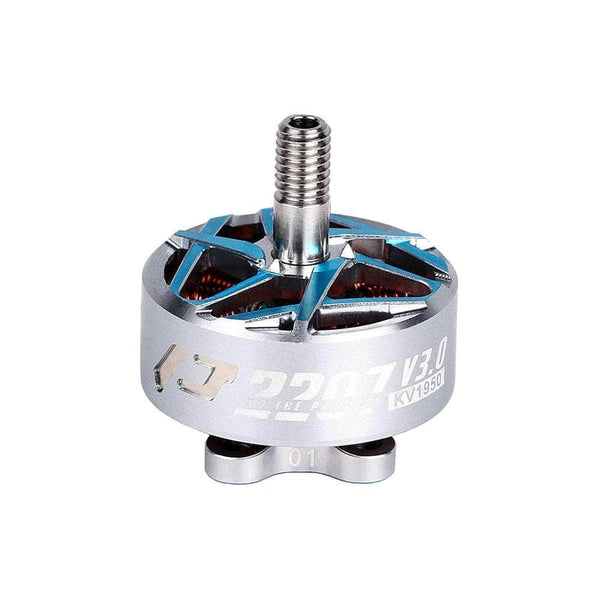
| Stator | 2207 |
|---|---|
| KV options | 1750, 1950, 2080, 2550 |
| Weight | 34.2 g |
| Shaft | 4mm |
| Max cells | 6S (1750/1950KV) / 5-6S (2080KV) / 4S (2550KV) |
| Configuration | 12N14P |
| Dimensions | Ø28.1x31 mm |
| Max thrust | 1815.3 g |
| Price (approx.) | 29.99 USD |
At 34.2 g it is right at the class average across the 39 2207-class motors in our database (avg 33.2 g).
Thrust data (T-Motor bench test)
| KV | Prop | Battery | Throttle | Current | RPM | Thrust | Efficiency |
|---|---|---|---|---|---|---|---|
| 1750 | T-Motor P49436-3 | 6S | 20 | 2.3 A | 12566 | 229.5 g | 4.01 g/W |
| 1750 | T-Motor P49436-3 | 6S | 40 | 7.6 A | 19159 | 571.4 g | 2.97 g/W |
| 1750 | T-Motor P49436-3 | 6S | 60 | 14.0 A | 23193 | 853.4 g | 2.42 g/W |
| 1750 | T-Motor P49436-3 | 6S | 80 | 23.0 A | 28065 | 1283.6 g | 2.23 g/W |
| 1750 | T-Motor P49436-3 | 6S | 100 | 37.9 A | 32448 | 1696.9 g | 1.8 g/W |
| 1950 | T-Motor P49436-3 | 6S | 20 | 2.6 A | 13110 | 259.3 g | 3.93 g/W |
| 1950 | T-Motor P49436-3 | 6S | 40 | 9.2 A | 19960 | 634.4 g | 2.75 g/W |
| 1950 | T-Motor P49436-3 | 6S | 60 | 16.9 A | 24042 | 928.1 g | 2.19 g/W |
| 1950 | T-Motor P49436-3 | 6S | 80 | 28.1 A | 28976 | 1378.8 g | 1.97 g/W |
| 1950 | T-Motor P49436-3 | 6S | 100 | 43.8 A | 33011 | 1760.1 g | 1.62 g/W |
| 2080 | T-Motor P49436-3 | 6S | 20 | 2.5 A | 12504 | 227.9 g | 3.94 g/W |
| 2080 | T-Motor P49436-3 | 6S | 40 | 8.8 A | 19131 | 581.0 g | 2.89 g/W |
| 2080 | T-Motor P49436-3 | 6S | 60 | 16.1 A | 23133 | 844.3 g | 2.3 g/W |
| 2080 | T-Motor P49436-3 | 6S | 80 | 26.0 A | 27794 | 1256.0 g | 2.13 g/W |
| 2080 | T-Motor P49436-3 | 6S | 100 | 41.9 A | 31901 | 1628.4 g | 1.72 g/W |
| 2550 | T-Motor P49436-3 | 4S | 20 | 2.9 A | 11241 | 177.1 g | 3.63 g/W |
| 2550 | T-Motor P49436-3 | 4S | 40 | 9.2 A | 17463 | 466.6 g | 3.04 g/W |
| 2550 | T-Motor P49436-3 | 4S | 60 | 16.5 A | 21322 | 714.3 g | 2.61 g/W |
| 2550 | T-Motor P49436-3 | 4S | 80 | 26.7 A | 25214 | 1013.4 g | 2.3 g/W |
| 2550 | T-Motor P49436-3 | 4S | 100 | 42.9 A | 29349 | 1392.1 g | 1.99 g/W |
| 1750 | T-Motor T5143S-3 | 6S | 20 | 2.4 A | 12280 | 223.8 g | 3.75 g/W |
| 1750 | T-Motor T5143S-3 | 6S | 40 | 7.7 A | 18796 | 566.2 g | 2.94 g/W |
| 1750 | T-Motor T5143S-3 | 6S | 60 | 14.4 A | 22865 | 849.7 g | 2.35 g/W |
| 1750 | T-Motor T5143S-3 | 6S | 80 | 23.5 A | 27707 | 1285.7 g | 2.19 g/W |
| 1750 | T-Motor T5143S-3 | 6S | 100 | 38.4 A | 31869 | 1677.2 g | 1.76 g/W |
| 1950 | T-Motor T5143S-3 | 6S | 20 | 2.7 A | 12850 | 249.8 g | 3.71 g/W |
| 1950 | T-Motor T5143S-3 | 6S | 40 | 9.3 A | 19765 | 618.9 g | 2.66 g/W |
| 1950 | T-Motor T5143S-3 | 6S | 60 | 16.8 A | 24072 | 928.4 g | 2.2 g/W |
| 1950 | T-Motor T5143S-3 | 6S | 80 | 28.3 A | 29157 | 1376.3 g | 1.95 g/W |
| 1950 | T-Motor T5143S-3 | 6S | 100 | 45.1 A | 33467 | 1815.3 g | 1.63 g/W |
| 2080 | T-Motor T5143S-3 | 6S | 20 | 2.7 A | 12505 | 233.4 g | 3.66 g/W |
| 2080 | T-Motor T5143S-3 | 6S | 40 | 9.4 A | 19243 | 592.1 g | 2.63 g/W |
| 2080 | T-Motor T5143S-3 | 6S | 60 | 17.5 A | 23263 | 872.3 g | 2.09 g/W |
| 2080 | T-Motor T5143S-3 | 6S | 80 | 28.0 A | 28086 | 1320.6 g | 1.99 g/W |
| 2080 | T-Motor T5143S-3 | 6S | 100 | 44.0 A | 31754 | 1668.3 g | 1.61 g/W |
| 2550 | T-Motor T5143S-3 | 4S | 20 | 3.0 A | 11071 | 176.1 g | 3.54 g/W |
| 2550 | T-Motor T5143S-3 | 4S | 40 | 9.3 A | 17098 | 470.2 g | 3.01 g/W |
| 2550 | T-Motor T5143S-3 | 4S | 60 | 16.7 A | 21031 | 696.3 g | 2.51 g/W |
| 2550 | T-Motor T5143S-3 | 4S | 80 | 27.4 A | 24871 | 1026.7 g | 2.27 g/W |
| 2550 | T-Motor T5143S-3 | 4S | 100 | 43.7 A | 28944 | 1372.5 g | 1.93 g/W |
Manufacturer bench figures (T-Motor bench, two T-Motor 5in props (P49436-3, T5143S-3) across four KV: 1750, 1950 and 2080 KV at 6S, 2550 KV at 4S; 5 throttle points (20-100% in 20% steps) on each); real-world thrust varies with ESC, battery sag and prop condition.
Pacer V3.2 2207 vs other 2207 motors on 6S
The same thrust costs different power on different motors. Each line is one maker's own bench series (6S, its own prop), drawn as grams of thrust per watt against thrust, so a higher line makes that thrust for less battery current. Throttle percent is left out on purpose: it means something different on every maker's rig.
| Motor | KV | Prop | Peak thrust | At 1350 g | |
|---|---|---|---|---|---|
| T-Motor Pacer V3.2 2207 | 1950 | T-Motor T5143S-3 | 1815 g at 1114 W | 688 W (1.96 g/W) | |
| T-Motor F60 Pro IV V2 2207.5 | 1950 | T-Motor T5150 Tri-Blade | 1838 g at 950 W | 590 W (2.29 g/W) | |
| T-Motor VELOX V2 2207 | 1950 | T-Motor T5147 | 1879 g at 1003 W | 555 W (2.43 g/W) | |
| Axisflying AF2207.5 | 1960 | GF 51466 V2 | 1388 g at 1010 W | 963 W (1.4 g/W) | |
| Axisflying C227 | 1960 | 5x5 three-blade | 1583 g at 1049 W | 797 W (1.69 g/W) | |
| Axisflying x SupaflyFPV x SyncFPV 2207.5 | 1960 | BB4943.5 | 1819 g at 962 W | 610 W (2.21 g/W) |
Power at 1350 g is read off each maker's curve, straight-line between its two nearest bench points; 1350 g is the highest thrust every motor here reached. Different props and rigs move these curves as much as the motor does, so compare rows on a similar prop. Peak thrust of every 2207 motor: 2207 motors compared. How to read a bench table: reading motor bench tables.
Thrust-to-weight with this motor
Four T-Motor Pacer V3.2 2207 motors at 1815.3 g max thrust each give 7261.2 g: 2:1, the minimum to fly, up to 3630.6 g all-up; 4:1 (freestyle) up to 1815.3 g; 8:1 (racing) up to 907.65 g.
RPM & prop speed on this motor
Props in this motor's class
| Prop | Size | Blades | Weight |
|---|---|---|---|
| Gemfan Long Range 5126-2 Durable 1.5mm T-Mount | 5.1x2.7 | 2 | 2.6 g |
| HQProp DP 5.1x2.5x3 | 5.1x2.5 | 3 | 3.1 g |
| HQProp Juicy J37 | 4.9x3.7 | 3 | 3.4 g |
| HQProp Juicy J40 | 5.1x4.0 | 3 | 3.4 g |
| Gemfan 4935 Sbang 3-Blade | 4.9x3.5 | 3 | 3.45 g |
Where this data comes from
Bench rows, configuration and dimensions are from T-Motor's own "P2207 V3 Product Drawing", "P2207 V3 Specifications" and "P2207 V3 Test Report" images on tmotorhobby.com/goods-1181.html, where the motor is sold as P2207 V3 and RaceDayQuads sells it as Pacer V3.2 (its own prose calls it V3-2). Identity is the four KV our listings sell - 1750, 1950, 2080 and 2550 - each appearing as a Specifications block and as a Type in the report, which with the P2306 V3's three is exactly the "7 different KV" the brand's own banner claims for the Pacer V3 line, plus the 2207 stator, a 4 mm shaft, 12N14P and 20# 150 mm leads. weight_g is corrected 37.3 -> 34.2 g and the Pyrodrone citation it came from is dropped: pyrodrone.com/products/t-motor-velox-v3-2207-1750kv-motor is the VELOX V2207 V3.0 (goods-1369), a different T-Motor 2207 that this catalogue publishes separately as t-motor-velox-v2207-v3-0-2207, and its 37.3 g, 5 mm shaft, 814.3 W and 34.6 A are that motor's 1750 KV block to the digit. Our second-source enricher matched the two on brand + stator + one shared KV, which is not enough to tell two 2207 V3 motors apart. T-Motor's own blocks give 34.2 g at 1750 KV, 34.3 g at 1950, 34.1 g at 2080 and 34.2 g at 2550, all including cable, so the published figure is the one two of the four windings share; idle current at 10 V is 1.2 / 1.35 / 1.4 / 2.25 A. max_cells stays 6S, the rating of three windings of four: the 2550 KV one is rated 4S and is benched at 16.8 V while the other three run at 6S. The spec-block cross-check lands on three windings of four and on two different runs: at 1750 KV the block's Max. Power (60s) / Peak Current (60s) is the T5143S-3 100% row (952 W / 38.4 A against 952.8 W / 38.4 A) and that row is both columns' maximum; at 1950 KV the 1085 W / 44 A is the P49436-3 100% row rounded (1084.5 W / 43.8 A) and is not the winding's maximum, which is T5143S-3's 1115.9 W / 45.1 A; at 2550 KV the 713 W is T5143S-3's 713.0 W exactly while the 43.6 A beside it is in no row of that winding's table and sits 0.1 A below its own highest current, 43.7 A; and at 2080 KV the 1037 W is above every power in its own table, whose highest is T5143S-3's 1036.2 W, with the 44 A beside it that row's 44.0 A. All 40 rows match the efficiency printed beside them against the sheet's own power column AND reproduce that column as voltage x current with no prop run carrying an offset - the largest per-run mean is 0.055 A, inside the rounding of a current column printed to 0.1 A - so nothing went into ACCEPTED_EFF. Two source facts recorded rather than repaired: the two props are benched on different packs at 2080 KV, P49436-3 at 23.0 V falling to 22.6 and T5143S-3 at 24.0 falling to 23.5, although the Testing graph labels both runs 23V; and the drawing calls out 4-M3 with a plain 16 between the top and bottom holes and a plain 16 between the left and right holes, which is a 16 mm bolt circle and not the 16x16 square the mount column holds, so mount_mm stays empty for the twelfth T-Motor page running. Its 12 description images are 7 marketing tiles dated 20221110 followed by the 5 sheet images dated 20220411 - the older set last - of which 08 is the drawing, the whole Specifications block and the first three report rows, 09 and 10 the rest of the report, and 10-12 the four Testing graphs and the Contents panel. Both tile joins were cropped and appended bottom-against-top and both are seamless.